
Native DLC & 1.2 PUE: Voltekko’s formula for optimizing the TCO of your AI inference workloads
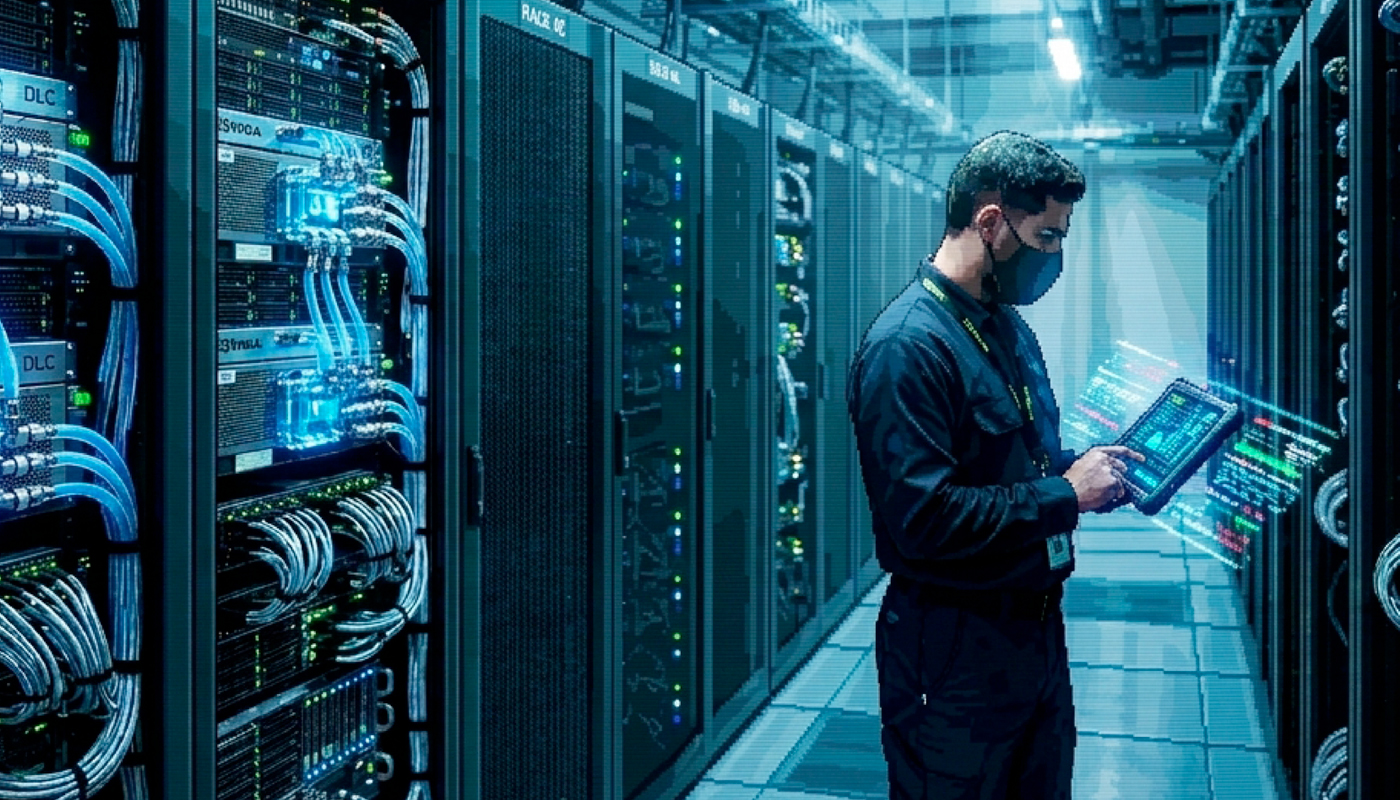
At the scale of several billion tokens processed per day, the profitability of an AI neo-cloud often comes down to fractions of a cent per token. Infrastructure is no longer a fixed cost to absorb — it is the variable that determines whether margins hold or collapse. Voltekko designed its European colocation network around two foundational technical choices: native Direct Liquid Cooling (DLC) and a target PUE of 1.2. Here is what that concretely changes for the TCO of AI inference.
TL;DRAt 3 MW IT, a PUE of 1.2 instead of 1.5 represents €1.18 million in annual savings on auxiliary power consumption alone. Voltekko achieves this through native DLC integration (70%) designed from the ground up, not retrofitted afterward. Behind it: EQUANS for operations, REED for financing, dedicated 3–4 MW IT blocks over 6-to-9-year commitments, deployed in 10 to 12 months where the industry standard is 18 to 24 months.
Why large-scale AI inference is driving neo-cloud costs through the roof
Artificial intelligence — particularly large-scale inference — is inherently resource-intensive. Language models, computer vision, and generative AI applications require thousands of GPUs running continuously, creating massive energy and thermal demands.
Understanding the energy consumption of high-density AI workloads
An NVIDIA H100 consumes up to 700 W. Aggregate dozens of them in a single rack, and you quickly reach 50 to 70 kW per rack, sometimes more. This density generates heat levels that traditional infrastructure — typically designed for 5 to 15 kW per rack — cannot handle without major compromises.
Even optimized air-cooling systems struggle to dissipate this heat without significant auxiliary power consumption directly impacting operational costs. Adapting an air-cooled infrastructure for high-density AI workloads may be manageable at first, but it becomes extremely costly at scale.
How cost per token became the real profitability metric for neo-clouds
For neo-cloud operators that have shifted toward AI, cost per token is now the core economic metric. Every processed request carries a micro-infrastructure cost and generates micro-revenue. In high-volume inference markets, margins are won or lost on these tiny differences.
The energy component is often underestimated in this equation. It includes not only GPUs, but also cooling, networking, storage, and every auxiliary datacenter system. At the scale of 3 to 4 MW IT, any inefficiency translates into several million euros in additional annual costs.
Voltekko’s answer: native DLC infrastructure purpose-built for AI
Voltekko designed its datacenters specifically for high-density AI workloads from the ground up, rather than adapting legacy facilities.
When DLC-native infrastructure is built for GPU racks
Direct Liquid Cooling cools high-heat components (GPUs, CPUs, memory) directly instead of cooling the ambient air in the room. Heat transfer is significantly more efficient, and auxiliary power consumption is reduced.
At Voltekko, DLC is integrated from the design phase: 70% liquid cooling, with only 30% residual air cooling. The infrastructure is engineered for racks ranging from 70 to 100 kW. This is not a retrofit — it is a fully integrated architecture, from flooring to fluid distribution systems. It also provides headroom for future GPU generations, whose power densities continue to rise.
A target PUE of 1.2 as a direct lever for massive savings
PUE (Power Usage Effectiveness) measures the overall efficiency of a datacenter: the ratio between total energy consumed and the energy actually used by IT equipment. A PUE of 1.0 would be perfect. In reality, 1.5 is still common across the industry, and getting below 1.3 with air cooling alone remains difficult.
Voltekko targets 1.2. Reaching this level is only possible by drastically reducing non-IT power consumption, and this is where native DLC plays its key role: fewer fans, less heavy air conditioning, and lower auxiliary losses. This PUE is the result of precise architectural design, validated and operated by EQUANS (a Bouygues subsidiary), which oversees construction and operations with more than 20 years of expertise in this field.
PUE 1.2 vs 1.5: what savings over one year at 6 MW IT consumption?
To find out, we invite you to download our guide, which provides all the details on the subject.
What the real TCO of AI inference includes beyond PUE
Optimizing TCO goes beyond PUE alone. It also includes cost predictability, regulatory compliance, and deployment speed.
How datacenter efficiency factors into cost-per-token calculations
A PUE of 1.2 reduces the “energy” share of the cost-per-token equation. But other elements also matter. High-density colocation optimizes space utilization, connectivity, and day-to-day operations, avoiding the hidden costs of inadequate infrastructure. Outsourcing physical-layer management to a specialized operator also frees internal teams to focus on AI itself while reducing indirect staffing costs tied to infrastructure management.
What 6-to-9-year capacity commitments change for TCO
Hyperscalers typically offer variable pricing and short-term commitments, making 3-to-5-year financial projections difficult. Voltekko offers 6-to-9-year contracts on dedicated capacity blocks of 6 to 7 MW IT per client. This duration provides cost stability and capacity visibility that are critical for product roadmaps and fundraising strategies.
100% renewable energy and near-zero WUE: what it really changes for ESG compliance
Running on 100% renewable energy is now a baseline expectation, not a differentiator. What matters more is combining it with a PUE of 1.2 and near-zero Water Usage Effectiveness (WUE) enabled by DLC, which concretely reduces the environmental footprint of AI workloads. For companies subject to ESG reporting requirements (CSRD, EED Directive), this translates into tangible operational benefits: lower non-compliance risk, smoother investor due diligence, and easier responses to enterprise customer requirements.
Why Voltekko is the right partner to scale AI inference in Europe
Deployment in 6 to 9 months: what that means compared to the industry’s 18–24 months
Industry deployment timelines typically range from 18 to 24 months. Voltekko commits to 6 to 9 months for dedicated capacity blocks.
In summary, the cost of large-scale AI inference has become a direct profitability challenge for neo-cloud providers. Voltekko built its infrastructure around two concrete levers: native DLC engineered for high-density GPU racks, and a target PUE of 1.2 that translates into measurable savings on every token generated. Backed by EQUANS and REED, and supported by 6-to-9-year capacity commitments, Voltekko is designed to support AI scaling across Europe. It is the first European colocation network built natively around DLC, designed exclusively for high-density AI inference workloads.
To learn more, download our TCO guide